
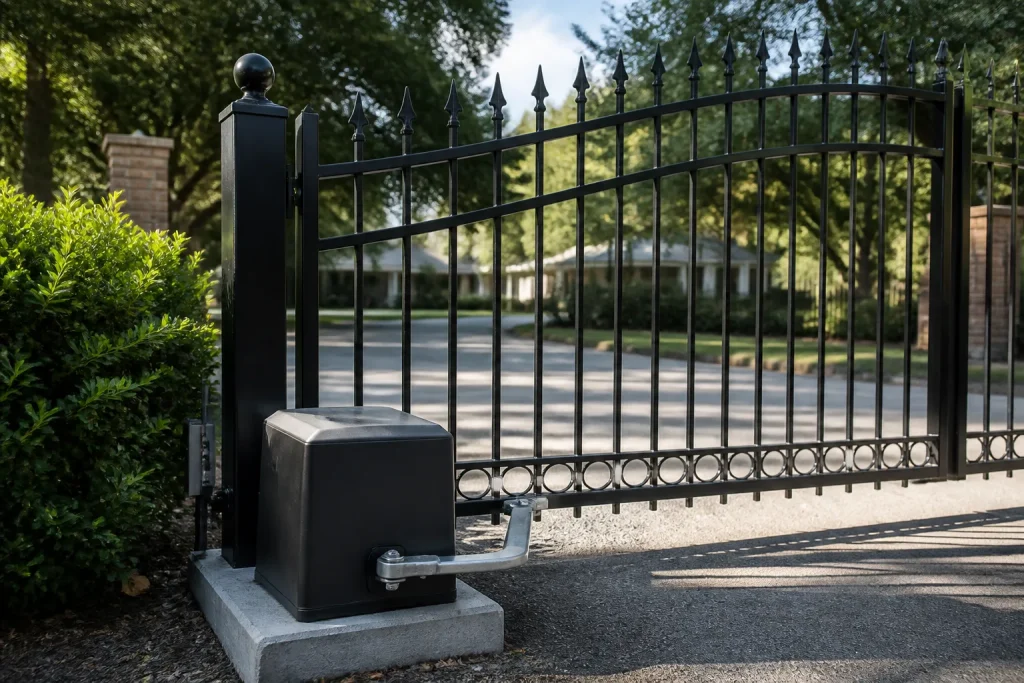
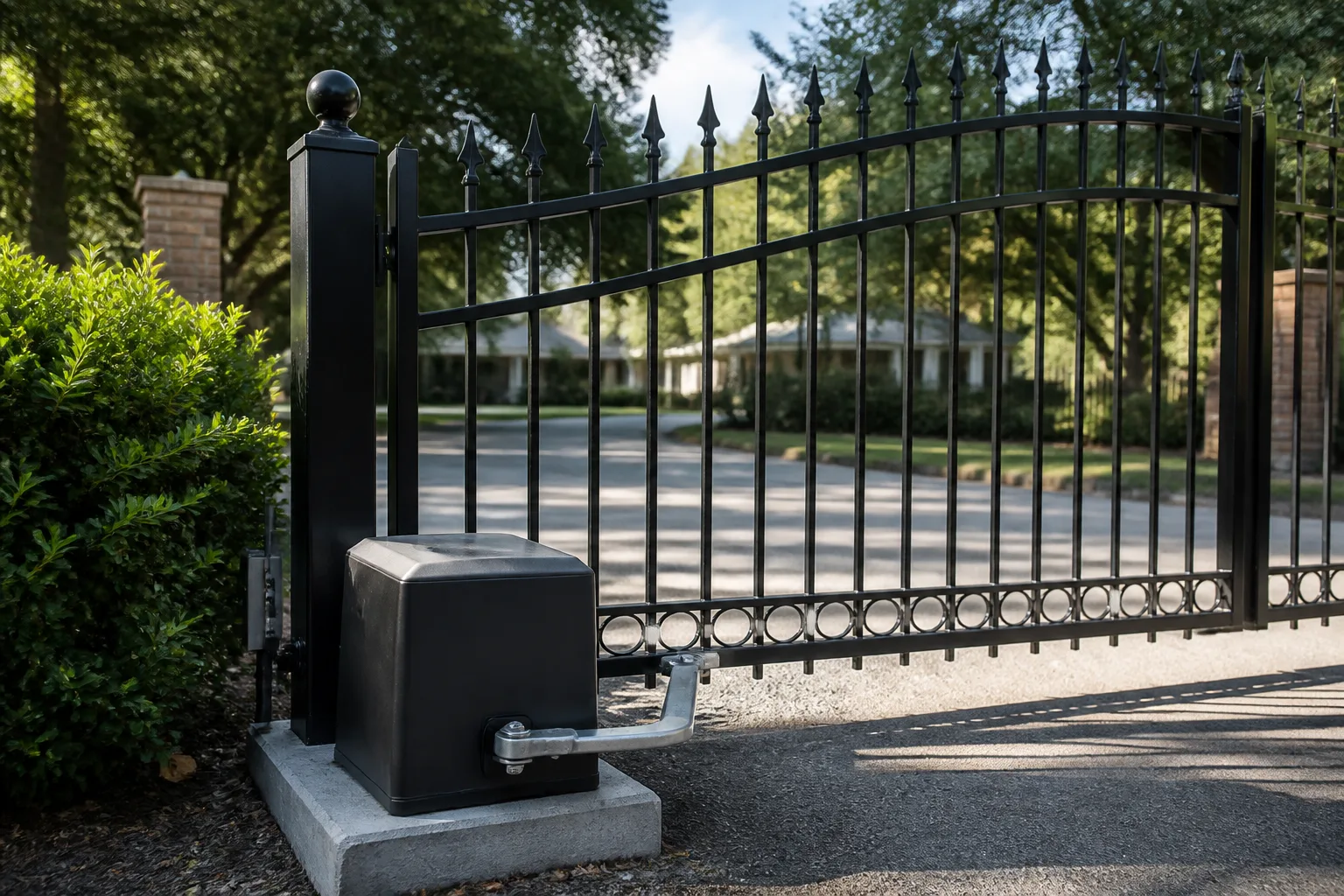
DoorKing Gate Repair in Duncanville: A Homeowner’s Guide
DoorKing gate repair in Duncanville usually comes down to one of three things: a control board that’s been cooking in the Texas sun for fifteen years, a loop detector that’s drifted out of adjustment, or a limit switch that’s worn out. The gate still moves, so it feels like a minor annoyance. But DoorKing systems telegraph trouble for weeks before they quit entirely, and most homeowners never see it coming because nobody told them where to look. If you’d rather skip the detective work and have a technician who knows DoorKing inside and out handle it, call us at (903) 532-2236.
This guide covers the warning signs DoorKing gates actually give you, the models we see most in Duncanville subdivisions, and what separates a real DoorKing repair from a guess that costs you more money.
First Things First: Reading the Blinking Light on Your DoorKing Control Board
Every DoorKing 1800, 1802, and 9050 has a diagnostic LED on the control board, and that little light blinks in patterns that tell you exactly what the system thinks is wrong. Most homeowners in Duncanville never know the light exists because the board sits inside a gray metal cabinet near the gate, and the display isn’t exactly user-friendly.
Here’s the plain-English version of what those blinks mean:
- One blink, repeating: The gate hit an obstacle or the current sensor tripped. Check for debris in the track, a sagging hinge, or a warped gate leaf binding against the post.
- Two blinks: The system sees a short or an open in the safety loop. In Duncanville, this often traces back to a loop detector wire that’s degraded from years of ground settlement and summer heat cycling.
- Three blinks: The reverse loop or exit loop is sending a constant signal. The gate thinks a car is permanently sitting on the loop, which is why it either won’t close or reverses for no apparent reason.
- Four blinks: Communication fault between the board and a peripheral, usually a keypad, telephone entry system, or a receiver card that’s worked loose.
- Steady light (no blink): Power is reaching the board. If the gate still won’t move, you’re looking at a relay, a motor capacitor, or a motor itself.
Reading these codes costs nothing and takes about two minutes. Nine times out of ten, a homeowner who calls us has already spent a weekend trying to fix the wrong thing because nobody showed them the code. That’s the trap DoorKing’s longevity creates: the gate works often enough that you tolerate the weird behavior until the board finally gives out.
Why Duncanville Heat Makes DoorKing Loop Detectors Drift
Duncanville summers push surface temperatures past 140 degrees on asphalt driveways, and that heat does something specific to DoorKing loop detectors: it shifts their sensitivity. The detector is essentially a radio receiver tuned to the inductance of a wire buried under your driveway. When the ground expands and contracts, or when the wire’s insulation gets brittle from heat, the detector drifts out of calibration.
What that looks like in practice:
- The gate closes, then immediately reopens, even though nothing crossed the loop.
- The gate won’t close at night or won’t close during the hottest part of the day.
- The gate opens and closes fine for weeks, then acts up for a day or two after a heavy rain.
We pulled a DoorKing 9050 out of a driveway over in the Ten Mile Creek area last August where the homeowner had been told by another company that the motor was shot. The quote was over $1,100. Ten minutes with a small flathead screwdriver to reset the loop detector sensitivity, and the gate closed like the day it was hung. The motor was fine. This is why we tell people: before you approve a motor replacement on a DoorKing, have someone check the loop detector tuning. It’s a $15 adjustment that gets misdiagnosed as a $400 motor all the time.
The DoorKing Models We See Most in Duncanville Subdivisions
Drive through older Duncanville neighborhoods, particularly the ones built in the 1980s and 1990s, and you’ll see a lot of original DoorKing 1800 and 1802 systems still running. That’s a testament to how well these things were built. But each model has its own personality.
DoorKing 1800 (the classic workhorse): The original board was all through-hole components, which means it held up to voltage spikes that would fry modern boards. The weak point is the limit switch assembly, which is mechanical and wears out after fifteen to twenty years. When a 1800 gate drifts past its open or closed position and starts slamming or stopping short, it’s usually the limit switches.
DoorKing 1802 (the updated version): Newer microprocessor board and a few more features, but the board is more sensitive to moisture and power surges than the original 1800. We replace more 1802 control boards than any other DoorKing part. The good news: the board pulls out in about ten minutes, and a trained technician can have a new one in and programmed the same afternoon.
DoorKing 9050 (the slide gate): Slides are simpler mechanically than swing gates, but the 9050’s chain or belt drive needs periodic tension adjustment. A loose chain makes the gate sound awful and eventually jumps the sprocket. Most 9050 issues trace back to either chain tension or the v-belt, not the motor.
The point is: when a homeowner tells us “it’s a DoorKing, the gate just stopped,” we already know the likely culprits based on the model and the symptoms. That’s the difference between a technician who knows DoorKing and a handyman who’s willing to take a look.
The Handyman Hazard: Why DoorKing’s Wiring Harness Bites Back
DoorKing uses a proprietary wiring harness and a specific programming sequence, and this is where we see good homeowners lose real money. A well-meaning handyman pulls the board to check connections, unplugs the harness, maybe probes a few pins with a multimeter, and plugs it back in. The board powers up, but the gate no longer responds to the keypad, or the close timer resets to zero, or the auto-close feature just vanishes.
What happened? The DoorKing board stores programming in volatile memory on some models. Pull the harness the wrong way or short the wrong two pins, and that memory wipes. Now you’re not just fixing a limit switch. You’re reprogramming the entire board from scratch, and if the board is old enough, it may not take a reprogram at all. A $200 repair just became a $900 board replacement, and nobody intended that.
We’re not saying DoorKing boards are fragile. They’re not. But they are specific, and they don’t like being poked at by someone who’s guessing. If you’re going to let someone work on your DoorKing, ask them one question: “Which DoorKing models have you worked on in Duncanville?” A technician who’s actually familiar with the brand will answer without hesitating.
What a Legitimate DoorKing Technician Should Tell You in the First Five Minutes
There’s a quick way to know whether the person standing in your driveway actually knows DoorKing or is about to learn on your dime. A DoorKing-experienced technician arrives, walks to the control cabinet, and within five minutes should be able to tell you:
- The specific model and approximate age of the board, based on the board revision and the component layout.
- What the diagnostic LED is doing right now and what that points to.
- Whether the loop detector has been re-tuned in the last few years, and what that means for the symptom you described.
- Whether the limit switches are mechanical or magnetic on your particular unit, and what that tells you about the failure you’re seeing.
- A rough cost range for the fix, with the exact number quoted and agreed before any work starts.
If the answer to any of those is a long pause or a vague “we’ll have to run some tests,” you’re probably not talking to a DoorKing specialist. That doesn’t make them dishonest. It just means they’re going to spend your money learning on the job. We’ve been called in behind enough of those jobs in Duncanville to know what they look like.
At Ironworks Gate Co., our technicians are trained on nine gate-automation brands, including DoorKing, LiftMaster, FAAC, and BFT, so the correct fix is made on the first visit, whatever is on the driveway. Most jobs are completed in a single visit, with the price settled before a single bolt is turned.
When to Call a Pro Instead of Digging Further
You can read the diagnostic codes. You can check for obvious debris in the track. You can look at the chain tension on a slide gate. But here’s where we draw the line: anything involving the control board’s internal wiring, the capacitor in the motor, or the high-tension spring on a swing gate arm is work for someone who does this every day. A garage door spring stores enough energy to seriously hurt you. A gate spring on a heavy steel driveway gate is no different, and DoorKing arms under tension are not something to disassemble without the right tools and training.
If your DoorKing gate is doing something it didn’t do last month, and you’ve checked the diagnostic light and the obvious mechanical stuff, call us. We’ll talk through what you’re seeing over the phone and tell you whether it’s something we need to look at in person. A live person answers every call, 24 hours a day, 7 days a week, at (903) 532-2236.
If you need more than a repair, our Gate Motor & Opener in Duncanville page covers full motor replacement options, and Gate Repair in Duncanville goes into detail on the full range of gate issues we handle. If a new gate is on your mind, start with Gate Installation in Duncanville.
The Bottom Line
DoorKing gates in Duncanville fail in predictable ways, and most of them give you warning signs before they quit. The diagnostic LED on the control board is the first place to look. The loop detector is the most commonly misdiagnosed component, especially in Texas heat. The model number tells you a lot about what’s likely wrong. And a handyman with a multimeter can turn a small repair into a big replacement if he doesn’t know DoorKing’s wiring harness.
If you’re in Duncanville and want a technician who can read the codes, tune the loops, and tell you exactly what’s wrong in the first five minutes, give us a call. Ironworks Gate Co. has been serving the area since 1984, and every job is backed by a written 90-Day Done Right Promise. Estimates are free. Call (903) 532-2236.
Frequently Asked Questions
Most DoorKing repairs in Duncanville run between $180 and $450 for common issues like limit switches, loop detector tuning, and relay swaps. Control board replacement typically falls between $600 and $950 depending on the model. The price is always quoted and agreed before any work starts, so there are no surprises on the bill. Call (903) 532-2236 for an exact quote on your specific DoorKing model, free.
In most cases, yes. DoorKing parts are common enough that our trucks carry the boards, limit switches, and loop detector components we use most in Duncanville, and most repairs are completed in a single visit. Call (903) 532-2236 and describe the symptom – we’ll tell you over the phone whether it’s a same-day fix.
That’s almost always a loop detector drift issue, especially if it happens more in hot weather or after rain. The detector is reading a phantom signal from the buried loop wire, and the gate thinks something is sitting on the loop. The fix is a sensitivity adjustment, not a motor replacement. We’ve corrected this in dozens of Duncanville driveways where the homeowner had been quoted for a new motor.
We offer $50 off any repair over $250, a free second opinion on any written estimate, an $89 seasonal tune-up, and a permanent 5% discount for seniors and veterans. Mention any of these when you call (903) 532-2236, and we’ll apply it to your DoorKing repair.
Written by Victor Salinas, Owner at Ironworks Gate Co., serving Duncanville since 2013.
Need Gate Repair Help?
Call Ironworks Gate Co. - licensed & insured, here with fast after-hours help in Duncanville.
(903) 532-2236